
Models of Disability
The way society has viewed disability over time has shifted and this has resulted in different models of disability. There are both historic and progressive models of disability. Click on the below accordion to learn more about the charity, medical and social models of disability.
The Charity Model of Disability
As the name suggests, the Charity Model of Disability was established due to the rise in support from charitable organisations for people with disability. While good in intent, the charity model paints people with disability as passive recipients of charity rather than capable members of society with unique experiences, skills and opinions.
The charity model of disability views people with disability as vulnerable and reliant in order to perform tasks.
(With Respect 2020 & DARU 2019)
The Medical Model of Disability
The medical model of disability implies that disability is a hardship and focuses on what people with disability cannot do, rather than what they can do. This model looks at what is wrong with the person and not what the person needs.
The medical model of disability views disability as a medical issue that needs to be treated or its impacts minimised. This responsibility is put solely on the individual with disability.
The Social Model of Disability
The Social Model of Disability holds a more contemporary view and defines disability as the result of interactions between people with disability and a society where physical, attitudinal, communication and social barriers exist.
The Social Model of Disability acknowledges that the issue of poor accessibility is a societal problem, not an individual one. It doesn't deny the impact of disability on a person or that people with disability may have medical needs, rather, the social model of disability implies that disability is simply a difference like race or gender and that society needs to adapt to allow people with disability to be fully participating and equal citizens.
The social model of disability considers that it's the environment that is inaccessible. This can be through physical spaces, language, services and communication. The individual receives prejudice, stereotyping and discrimination against them. Services are inflexible in their procedures and practice.
(With Respect 2020 & DARU 2019)
The illustration below highlights the difference between the medical model of disability and the social model of disability.
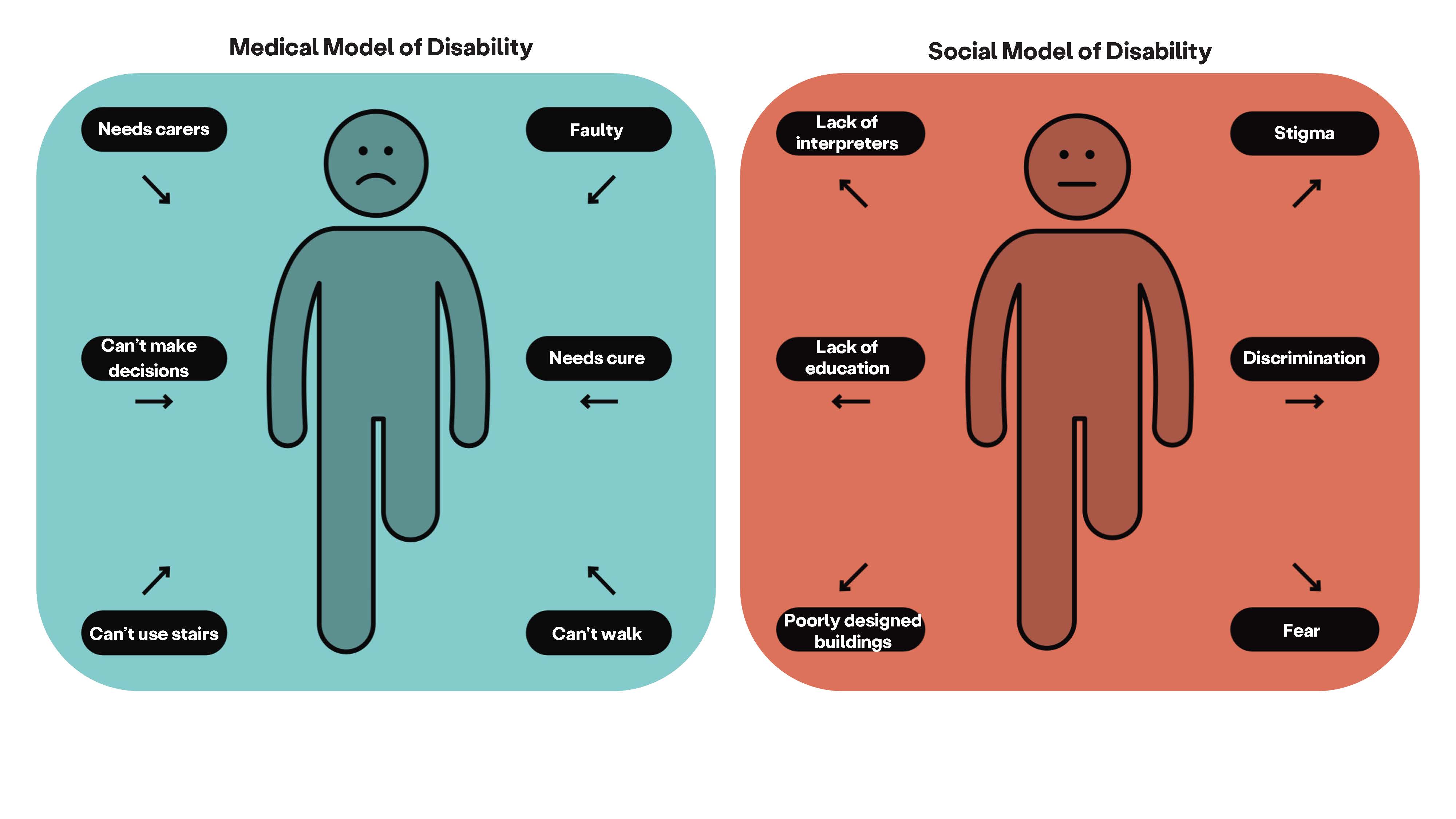
As hospital workers, engaging with people with disability from a person-centred approach, adapting communication style, advocating for accessibility standards beyond compliance, using equipment that can be customised to meet the individuals needs and offering choice and control, challenges the medical model of disability and supports the social model of disability.